
What is Tempeh?
Tempeh is a traditional food from Indonesia. Cooked legumes are fermented with a noble mould culture and grow together into a firm, sliceable block. At Lazybean, we make tempeh by hand in Hamburg – without soy.

How is tempeh made?
We cook the legumes, inoculate them with the tempeh culture and let them mature at a warm temperature. Depending on the legume, this takes different amounts of time, usually 24 to 48 hours. During this time, the culture grows through the beans and binds them into a block, similar to the ripening of cheese. The tempeh is then gently pasteurised, vacuum-packed, labelled and shipped chilled or delivered by bike around Hamburg.
In addition to our core range, there's a limited edition every month, for example with pumpkin seeds, sunflower seeds, hemp seeds, quinoa or sweet lupins. You'll find the current varieties in our tempeh shop.




Which culture is used for tempeh?
Tempeh is made with the noble mould Rhizopus oligosporus. It belongs to the order Mucorales and has been used for tempeh in Indonesia for centuries. During fermentation, it forms a white mycelium network that holds the block together and produces enzymes that break down parts of the proteins and carbohydrates. Fermentation makes the tempeh firm and sliceable, gives it its nutty, mushroomy flavour and helps it soak up marinades particularly well.

Is our tempeh soy-free?
Yes. Classic tempeh is made from soybeans – we use other legumes instead:
- Chickpea Tempeh: mild and buttery, our starter tempeh
- Black Bean Tempeh: bold and nutty
- Green Pea Tempeh: complex, with a distinct mushroom note
- Lazy Hack: chickpeas and black beans, ready-marinated as a mince

Where do the legumes come from?
Good tempeh starts with good legumes. That's why we choose our farmers carefully and buy directly from the farms, not through anonymous wholesalers. That way, we know with every delivery where our raw materials come from and how they were grown.
For our main varieties, we source:
- Chickpeas from Germany
- Black beans from Austria
- Green peas from Germany
- Sweet lupins from Germany
Want to know exactly which farm your chickpeas come from? Ask us anytime via our contact form – we're happy to tell you more about our suppliers.

What does tempeh taste like?
Tempeh tastes nutty with a subtle mushroom note. How strong it is depends on the legume: chickpea is mild, black bean bold, green pea the most intense. Tempeh absorbs marinades and spices very well, so it fits into almost any cuisine.

What's the difference between tempeh and tofu?
Tofu is made from soy milk, similar to how cheese is made from milk. Tempeh consists of whole, fermented legumes. This gives it more bite, its own flavour and the fibre of the whole bean. If you already cook with tofu, you can fry, bake, grill or marinate tempeh in exactly the same way.

What's the difference between tempeh and seitan?
Seitan is made from wheat gluten and is therefore not suitable for people who avoid gluten. Tempeh is made from legumes, contains fibre and is fermented. Both are good plant-based protein sources, but they taste completely different.

What does “fermented” mean?
In fermentation, microorganisms such as moulds, yeasts or bacteria transform a food. This creates new flavours and changes the texture. Almost all Lazybean products are fermented: tempeh with Rhizopus, soy sauce and koji rice with Aspergillus oryzae.
Fermented doesn't automatically mean “alive”: Our tempeh is pasteurised after maturing so that it keeps longer and can be shipped safely. This kills the tempeh culture, while the flavour and nutrients of the legumes are retained. Our soy sauce, on the other hand, is deliberately unpasteurised.
Read more: How to cook tempeh · Tempeh nutrition · How to store tempeh
Our Tempeh
-
Chickpea Tempeh Natural
Regular price €4,30 EURRegular priceUnit price €21,50/kg -
Black Bean Tempeh Natural
Regular price €4,30 EURRegular priceUnit price €21,50/kg -
Lazy Hack – Mediterranean
Regular price €5,00 EURRegular priceUnit price €26,32/kg -

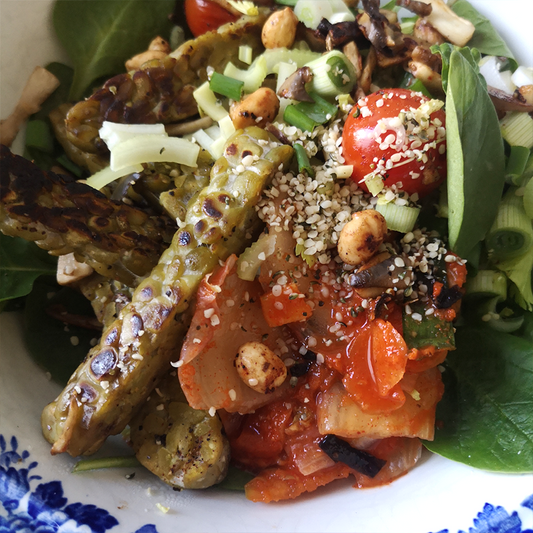 Sold out
Green Pea Tempeh Natural
Regular price €4,30 EURRegular priceUnit price €21,50/kg






Collections
-

Tempeh topping
Here you'll find our tempeh toppings – a quick and easy way...
-

Sets & Tasting Packs
Tempeh bundle – plant-based variety in one set Our tempeh bundle brings...


